What are the biggest marketing trends for 2026?
I’m noticing three very specific shifts happening in marketing right now that almost nobody is talking about.
And I promise you, this isn’t the same old generic advice you’ve heard a million times.
So if you’re a business owner, creator, or copywriter trying to figure out what’s actually working right now (not what worked two years ago)…
This is for you. There are 3 trends that I’m paying very close attention to right now, and I’m telling you, #3 is a little spicy.
By the way, if you’re new here, I’m Alex! I’m an award-winning marketer, copywriter, and founder of the Copy Posse, where I teach over 400,000 rad humans from around the world to turn words into dollars, monetize their message and build businesses they love.
So yeah, watching, testing, studying and obsessing over what’s working in marketing is basically my full-time job, starting with..
Marketing Trend #1: Be Uncomfortably Specific
The advice “Stop trying to appeal to everybody” is nothing new. If you’ve been around here for a while, then you’ve heard me say this at least a million times.
And I’m not the only one.
But in 2026, “be specific” is taking on a whole new meaning.
Especially on social media and paid ads.
Because when there is an absolutely ridiculous amount of content competing for our attention in the age of cheap AI-produced garbage.
You want your people to see your post and immediately think: “Oh my god. That’s me. They are talking to me.”
And I’m not talking about simply narrowing in on your target audience and their universal fears, desires and values.
I’m talking about calling people out directly using clear and specific identifying information.
My friend Veronica Romney talks all about the power of Identity Marketing in her book by the same name.
But now it’s time to get even more specific.
I’m talking call it out, slap me in the face, I’m talking to you, yes you specific.
And there are a couple ways you can do this.
The first way is by being hyper specific about your ideal audience.
So you can call out exactly who they are, what they struggle with, or even some ridiculously specific thing they identify with that has nothing to do with your niche.
Like this example from Natalie Ellis, who is calling out her audience in a very specific way.
“For the high-functioning hyper independent millennial woman who’s given the last 15 years to her career.”

Yup, I’m talking that specific.
Or how about this one? “17 things that make sense when you find out she’s an entrepreneur and eldest daughter with a touch of ADHD.” Hi, it’s me.

Call out your audience so specifically. It feels a little weird.
The second way you can do this is actually a little more surprising and goes against the traditional marketing advice of always making it about your customer, not yourself.
Well, plot twist, try this.
Instead of calling out your audience directly, talk about things that are hyper-specific about you, like your personality type, what life stage you’re in, your interests, or even products you’re obsessed with.
My friend and social media strategist, Shannon McKinstrie, calls this “identity maxxing.”

I freaking love this. I think she absolutely nailed it here.
The idea is that when you share those specific things about you, the people who identify with you and those specific things find you.
I accidentally proved this with this random post. And the story behind it is actually hilarious.

So my hubby is a custom hat maker.
And he happened to be fitting me for a new cowboy hat right after I had this conversation with Shannon.
So I thought, what the heck, and decided to film it.
Now, you maybe can’t tell from there, but I have a big head, lol. And because this post was just for fun, rather than turning it into some strategic marketing lesson or trying to make it relevant to my audience.
I literally just talked about my big head. And you guys.
That post went off. At the time of recording this, it has almost 600,000 views, and it’s still on the rise.

People who had never heard of me, who had absolutely no idea who I was, found that post and started commenting.
I accidentally summoned all the big-headed baddies of the world.
And that’s when I realized it.
I gave the algorithm an incredibly specific group of people who would recognize themselves in that content.
Not “entrepreneurs.”
Not “women.”
And not “marketers.”
People with big heads! Ha!
And while this has literally nothing to do with my business, it did prove to me that this hyper-specific identity language really works.
So we decided to experiment with the same hyper-specific identity language in our ads for a masterclass I was running.
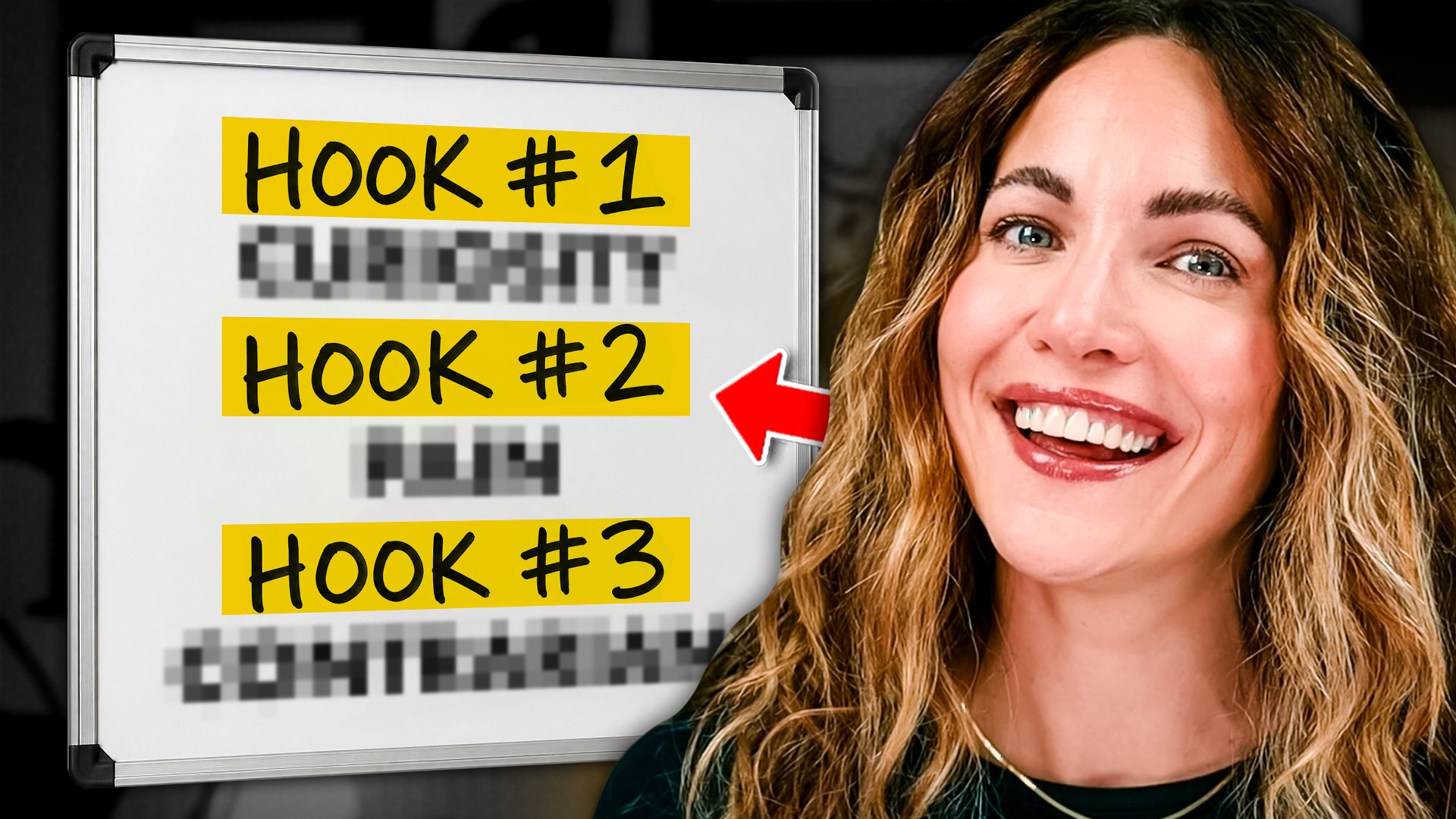
And yup, you guessed it, the best ads were hyper-specific. If you want the full breakdown of how we tested and scored each version, I’ve shared the complete hook data here.
Take a look at this first ad we tested.
“Escape the inconsistent-income rollercoaster & build reliable monthly income.”
Now this uses a pain/benefit hook, which can work great, but it’s not speaking to my audience’s identity.
And this ad only brought in 12 leads and the cost per lead was crazy high at $16, which is why we turned it off after only 12 leads.

Now compare that to these.
“The Smart Freelancer’s Cheat Code For Reliable Monthly Income.”
And “The Successful Freelancer’s Secret To Consistent Monthly Income.”
Both of these speak to the identity of who my audience is, not only “freelancers” but “smart freelancers” and “successful freelancers.”
And look how many more leads these ads brought in, 300 and 201, with a much lower cost per lead of ~$6.

And you better believe we are going to keep testing this in our ads and social content.
So remember, this trend isn’t about finding some magical phrase that hacks the algorithm. It’s about making it ridiculously easy for the right person to recognize this is for me.
And that brings me to Trend #2.
Marketing Trend #2: Video Is Dominating
Listen, I’m a writer. I love words.
But despite my love for writing, I have somehow managed to build my entire business around video.

I have a little secret behind why I’ve been so successful with creating video content, even though I was definitely “not a video person” when I started, and I’ll share that with you in a minute.
But first, here’s what’s important for you to know. For years, the data has shown that video is becoming increasingly effective as a marketing strategy, especially in the last year.
Take a look at HubSpot’s 2026 State of Marketing Report.

They surveyed more than 1,500 marketers worldwide about which media formats were driving the highest ROI.
The top four were all video.
Short-form video, 48.6%.
Long-form video, 28.6%.
Live-streaming video, 25.1%.
And UGC content (which is another form of short-form video), 24%.

All of these jumped up massively in the last year alone, with short-form video massively outperforming any other format.

Which might not be that surprising, if you’ve been anywhere on the internet lately, then you have absolutely noticed that it suddenly seems like everybody is “yapping” on social media.

But I want to make something clear, “yapping” does not mean “rambling.”
There’s sort of this unspoken notion floating around that “yapping” means aimlessly talking to camera without rhyme or reason.
I challenge that.
Because while I’m sure there are some people who can yap on command and share unscripted brilliance and stories off the cuff.
Most people, myself included, cannot.
The truth is, great videos aren’t lucky. They are planned. Even the ones that seem like they aren’t.
Talking to camera in a cool, casual way isn’t a personality trait. It’s preparation.
That is exactly why I script every video I create. This is the only reason I’ve become a “video person.”
And I’m willing to bet good money that even the best “yappers” are following a script or at least preparing talking points in advance.
So yeah, even though I create tons of video content, I am a writer first. Writing helps me create better videos, and I’ve broken down my exact hook framework here if you want to see how I approach the first few seconds of every script.
So if you’re already learning copywriting, you have a very special skill set that lends itself well to scripting video content for yourself and your clients.
And that’s why I think writers have a massive opportunity right now. To become the person behind the camera, writing short-form scripts, YouTube videos, webinars and VSLs for clients who desperately need video content.
This is a skill that business owners are actively looking for right now.


And if you’re a creator or business owner who does want to make your own videos, a great script means you don’t have to magically become good at “yapping.”
You can figure out what you want to say first, then turn on the camera feeling prepared and ready.
And that is exactly why I created HOOKED.

It’s my complete video scriptwriting program where you’ll learn the exact frameworks and blueprints I use to write short-form videos, YouTube videos, webinars and VSLs that hook attention, hold retention, build trust and drive action.
So whether you want to add scriptwriting as a high-value service.
Or you just want to create better videos for your own brand without trying to become somebody you’re not.
Go check out HOOKED.
Now, if you’re like, ok, but what if I want to build my own personal brand, but I really feel uncomfy on video? Got you. Because it’s about to make a lot more sense why I’m about to give you two strategies that don’t require video at all.
But first, we need to talk about trend #3, because it’s arguably the most important shift happening right now and it is really spicing things up.
Marketing Trend #3: Anti-Perfection Marketing
People are rebelling against perfection.
And honestly? I’m so here for it.
Luxury brands making TikToks that look like they were edited in 30 seconds.

Companies are roasting their own customers.

Blurry photos, photo dumps, screenshots, bad lighting, iPhone videos, and just plain strangeness.

Basically, everything we were told a “professional brand” should never do.
And this isn’t just happening in marketing.
I think we’re seeing this much bigger cultural shift where people are just.
Freaking exhausted from being told how to optimize every single freaking part of their lives.
Optimize your morning routine.
And optimize your sleep.
Optimize your diet.
And optimize your business.
Optimize your content.
Optimize your skincare routine.
And optimize your freaking water.
Do all the things. Buy all the things. Track all the things.
After years of hyper-curated feeds, picture-perfect personal brands, wellness routines, and productivity hacks.
People are finally saying, nah, I’m good.
We’re seeing this anti-perfection, anti-establishment energy creep into the culture.
Like, guys. Smoking is apparently coming back. Smoking. Okay, that one I can’t get behind.

Something we’ve collectively spent decades agreeing is a terrible idea is now making a cultural comeback.
Btw, don’t smoke, kids. I am not endorsing it. Obviously.
But culturally speaking, this is fascinating. And I kinda get it. It’s grungy, analog, nostalgic.
And I think it tells us a lot about the current zeitgeist.
Because I’m not convinced smoking is coming back just because of the taste. There is something really important underneath it.
People are so sick of constantly being told what they should do, what they shouldn’t do.
What’s healthy, what might be killing them.
What’s productive. And what’s cringe, what’s cool. How to make $10k in 10 days.
The pendulum is starting to swing back toward: “You know what? I’m just gonna do whatever the hell I want.”
And that attitude is showing up in marketing too. I’ve been noticing posts like this everywhere.
So naturally, I started experimenting with it in my own content.

I wrote an entire Substack article on the importance of joy-maxxing.

There’s this unapologetic, almost rebellious energy underneath them.

These are not posts that tell people how to be better, do better, or achieve more.
They are posts that play into the reality of being yourself and loving who you are and not apologizing or trying to change or alter yourself.
It’s about saying.
This is me. Not perfect. Flawed in many ways. But I’m here and I’m living my life. Take it or leave it.
People don’t want another perfectly polished person telling them how to improve themselves.
They want people who feel human, people are relatable.
Your quirks and opinions, even the controversial ones, are the things that will be attracting audiences right now.
Now, to be clear, this doesn’t mean to be controversial just to get attention.
It means loosening your death grip on perfection.
Let your personality, edges, and weirdness be seen.

Because in a world where everything can be optimized.
Being unapologetically human might actually be the ultimate rebellion.
And you can be unapologetically human without showing up on video. So for anyone reading this who heard Trend #2 and thought.
“Great. So now I have to create video to be relevant?!”
No. You don’t.
And you definitely don’t have to start carrying around a tiny microphone everywhere you go.

Remember, video is simply the medium and while the format is dominating right now, there are plenty of other ways you can share your unfiltered, baddie human self online.
Like a carousel, for example. I created a carousel sharing my toxic traits as an entrepreneur, and the response was amazing.

Or start writing on Substack. This is where I get things off my chest, spill my unfiltered tea, and share the messiest moments of entrepreneurship, leadership, and everything I’m not saying anywhere else (never, ever written by AI).

If you’re a copywriter or creator on the fence about it, I broke down why Substack might be your best move here.
The point I’m trying to make here is, no matter the medium.
Be you. Write, create, share your opinion, drop perfection and remember who you are. Until next time, I’m Alex. Ciao for now.