Is generative engine optimization the new SEO strategy every copywriter needs to know about?
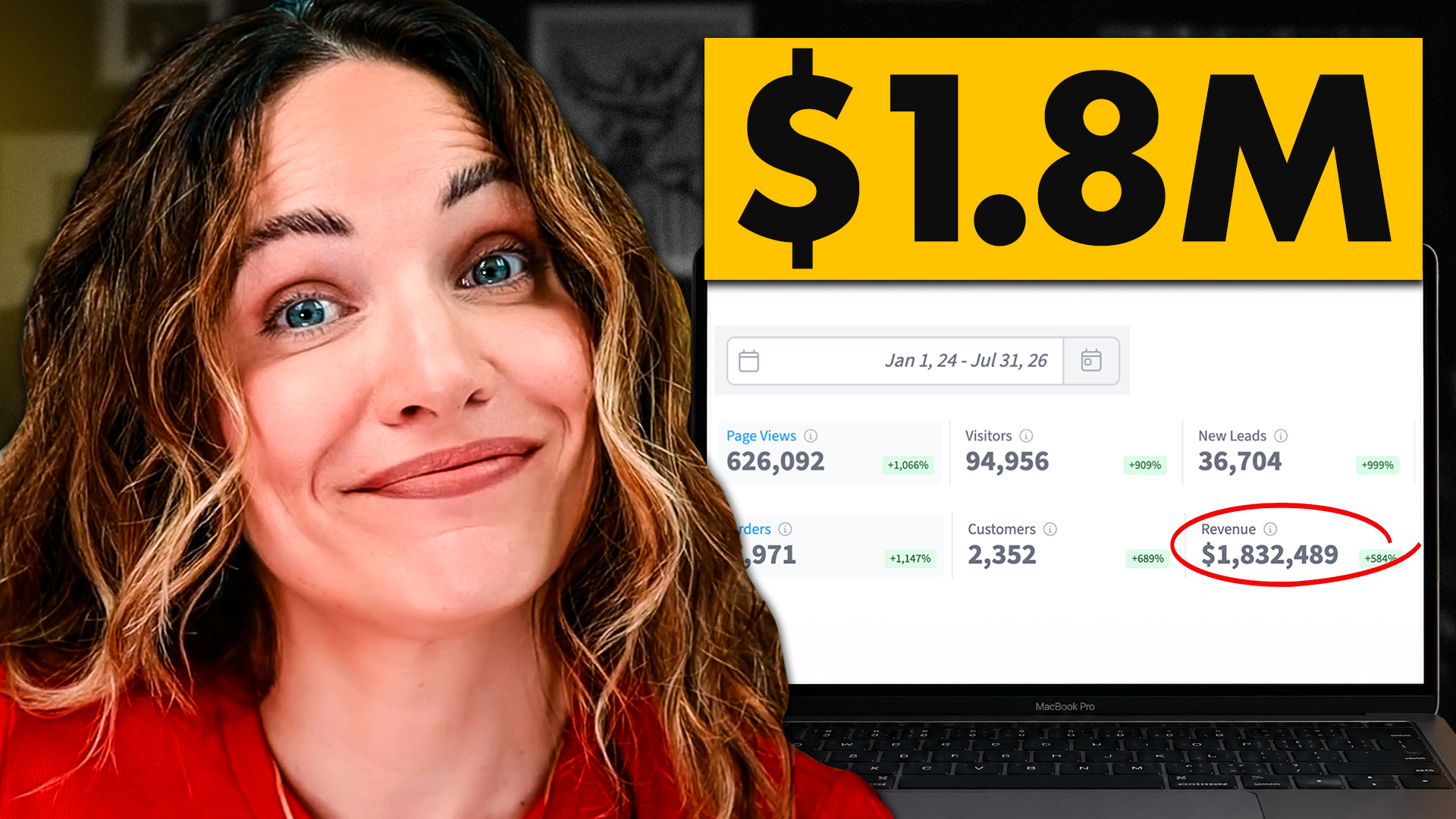
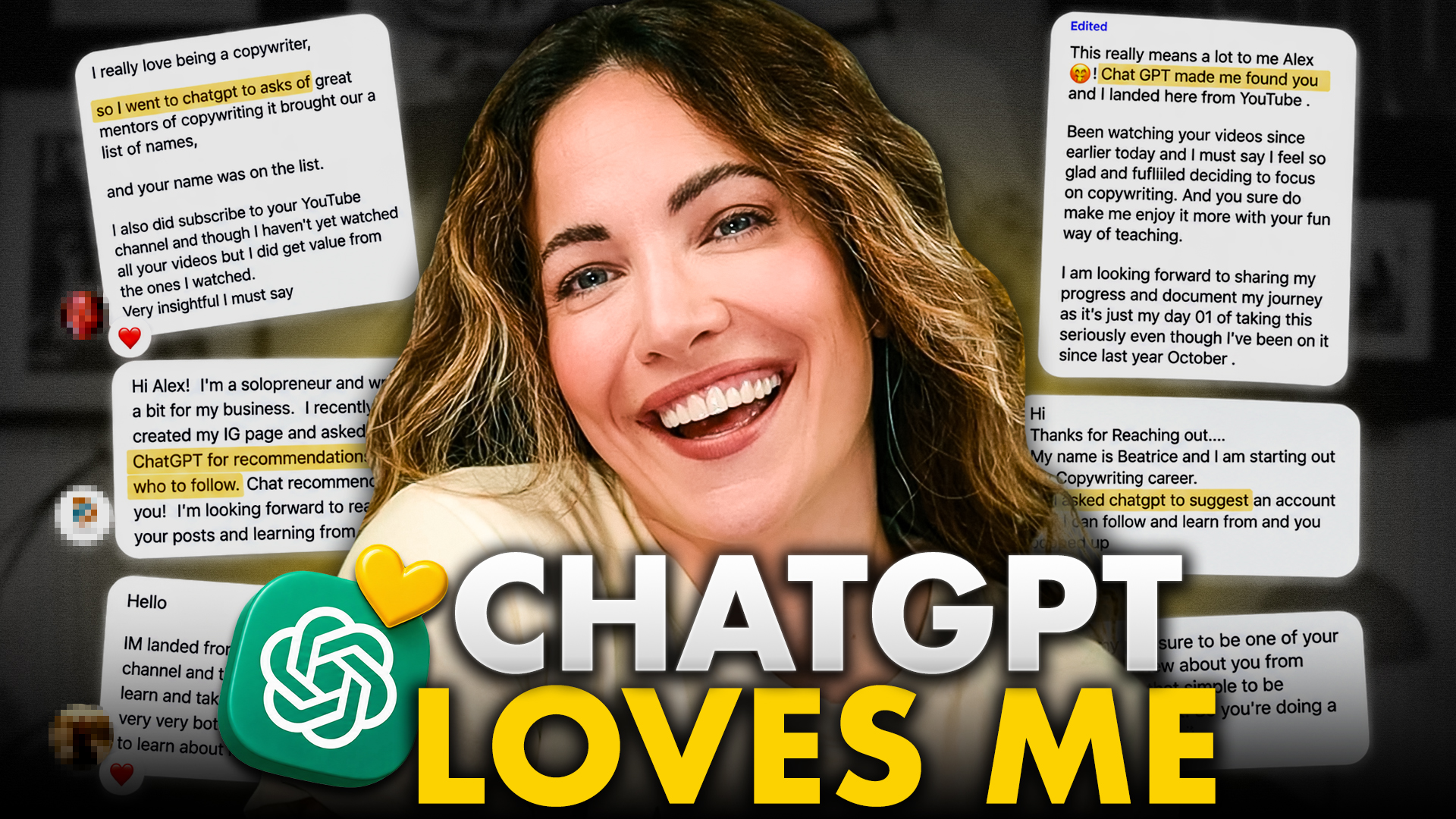
Everyone is obsessing over ranking at the top of Google. Meanwhile, hundreds of people have told me they found me on ChatGPT.
I have no idea how or why, and it’s about time I got to the bottom of this.
Hey, I’m Alex. Expert copywriter, award-winning marketer and the host of this blog where I teach over 400,000 rad humans on the Internet how to turn their words into income.
And the question I’m on the hunt to answer is this.
“How do I get AI to recommend me to my clients and customers?”

If that’s been on your mind too, you’re in the right place.
I’ll be honest, SEO has already been sort of an afterthought for me, but over the last few months, I’ve been spending more time digging into my metrics, learning from the pros, and rolling out new SEO strategies in my business.

And what I’ve discovered has been, well, very interesting, including a massive mistake I found buried in my website code that was stopping AI from finding and recommending me.
I’m still figuring this all out, but I wanted to take you along for the ride and share what I’ve learned so far, in case you find it helpful, too. (If you’re still working out where you personally land on AI use in your own business, this is how I use AI the right way as a starting point.)
If you’re a copywriter, marketer, SEO specialist, content creator, or service provider.
Learning this now won’t only help clients find you, but it could also make you incredibly valuable to your clients. So let’s get into it.
In this post, I’m going to show you the four stupidly simple steps that increase your chances of getting AI to recommend you, yes, even if you’re brand new in business or haven’t focused much on SEO before.
But first.
Is SEO Dead?
Despite what thousands of videos, social posts, and articles would have you believe, no, SEO is not dead.
Even Google itself has said that traditional SEO best practices remain foundational to appearing in its generative AI search features.

For the last 20+ years, ranking on Google has been every business’s goal for organic search traffic, and don’t get me wrong, that is still a great goal to have, but the game is changing.

Because now, customers aren’t just browsing search engine results. They’re asking AI directly.
And even if they do ask Google the same question, the result they get is no longer just a long list of websites.
It’s an AI answer that appears right there at the top of Google, also known as “Position Zero” or “Zero Click” search results.

And if you are mentioned in that answer or recommended by the AI tools your customers use, it could change everything for your business.
This is where Answer Engine Optimization, or AEO, comes in.
WHAT IS AEO?
My good friend Matt Diamante, SEO expert and founder of HeyTony SEO Agency, recently gave an epic training to my mastermind members, and I love what he said. “AEO is just SEO with a new coat of paint.”

While traditional SEO is largely about helping search engines discover, understand and rank your content.
AEO, also known as GEO = Generative Engine Optimization (yeah, because that’s what the Internet needs, more 3-letter acronyms.)
Is all about increasing the likelihood that an AI-powered answer engine can:
- Find you.
- Understand what you do.
- Trust you.
- And ultimately, cite or recommend you in its answer.
Which, yes, sounds a lot like traditional SEO, but ranking high on Google and getting mentioned by an AI aren’t necessarily based on the exact same factors.
One recent controlled study examined more than 250,000 citation decisions across six language models and found that topical relevance was among the strongest factors determining which source an AI cited first.

Along with other factors such as recency, data and other trust signals.
With SEO, we’ve been trained to think about which keywords people are searching for.
But with AEO, we need to start asking ourselves what questions our ideal customers are asking.
And if you follow these 4 steps you can start creating content that makes it much easier for AI to connect you with the questions you want to be recommended for.
And by the way, make sure you stick around, because at the end I’m going to walk you through a simple AEO Audit that you can run in just a few minutes to find the lowest hanging fruit for AEO optimization.
AEO STEP 1: FIND THE QUESTIONS
Remember, you’re not just trying to “rank” in the search results.
You’re trying to show up in the specific conversations that happen right before someone makes a buying decision.
So think about your customer’s buying journey and biggest objections.
- What would someone ask ChatGPT before they knew they needed you?
- What would they ask as they research their options?
- What would they ask when they’re comparing you to a competitor?
Let’s say your client is an accounting firm that specializes in small businesses.
A broad question might be: “What does a small business accountant do?”
Not bad, but also probably not the most valuable question to optimize for.
Compare that to these questions.
- “Do I need an accountant or bookkeeper for my small business?”
- “How much should a small business pay for accounting?”
- “What’s the best accountant for a business making over $1 million a year?”
Can you see how these questions are much more likely to be asked by someone? And that’s where you want to show up.
Some good ways to identify these questions.
- Run your topic through FindQuestions.com, AnswerThePublic or AlsoAsked to see real, phrased customer questions.
- Check the “People Also Ask” section after a Google search.
- Search Reddit and niche forums for how real people phrase the problem.
- Or you could literally ask ChatGPT/Claude/Perplexity what questions they get asked most about a specific topic. (If you want more ways to put ChatGPT to work in your business, I’ve also shared 5 new ChatGPT prompts worth trying.)
But here’s the problem.
Knowing the right question to target doesn’t mean AI will actually pick you as the answer. You could target the perfect question.
And still lose to a competitor with worse content, simply because they made it easier for AI to understand.
So once you know the questions, you need to win the next battle.
AEO STEP 2: BECOME THE CLEAR ANSWER
You need to give AI an answer that is worth recommending and this is where your content becomes incredibly important.
Now the goal here is not to create more generic content or AI slop.
The goal is to create content that provides the best possible answer to the questions that really matter.
You don’t just want to write a blog post that answers the question.
You want to write a blog post that breaks it down clearly.

It needs to be easy for AI to scan and understand the answer.
That means clarity, structure, specificity, all of these things matter, across your entire website.
A homepage headline that says: “Unlock What’s Possible” tells AI nothing valuable.
What do you sell? What do you do? And what results do you help your customers get?
If you want answer engines to understand that you’re a conversion copywriter specializing in SaaS, then you need to actually say that.

Clarity wins every single time.
So once you’ve written the clearest answer on the internet, but now what? As it turns out, AI doesn’t just trust what you say about yourself. It’s looking for third-party proof.
AEO STEP 3: BUILD AUTHORITY
Okay, let’s pretend for a minute that I own a pizza restaurant. And you come up to me and ask, “Hey, Alex! Where’s the best pizza restaurant in Vancouver?”
And I say: “Well, my restaurant. Duh!”
I mean, that’s not exactly compelling evidence, is it? But what if.
- Someone you know recommends me.
- The Vancouver Sun recommends me.
- Thousands of customers review me.
- Food bloggers write about me.
- Reddit users constantly tell tourists to go there.
- Local publications include me in their “Best Pizza” lists.
- And my restaurant’s own website clearly confirms where we’re located, what kind of pizza we serve and how long we’ve been doing it.
This matters because AI recommendations aren’t necessarily built exclusively from what you say on your website.
These systems can gather information about brands from reviews, articles, forums, directories, news coverage, social media accounts, and the list goes on.
Which means AEO isn’t just a content strategy. It’s also a PR and authority strategy.
Your goal is to create a consistent footprint of “authority” across the web that reinforces:
- This is who I am.
- This is what I do.
- This is who I’m best for.
- And I’m not the only one saying it.
So ask yourself, how can I get credible sources to talk about me in the context I want to own?
How can you incentivize your best customers to leave Google reviews? Can you partner with any related brands or companies? Can you appear in Podcasts?
How can you show up in more places than just your own website?
By the way, social media profiles like LinkedIn and even Instagram are now indexed by Google and have great domain authority at 99 and 94, respectively, which means these are great places to post authority content.

And you can even add some of your social profiles to your Google Search Console to track performance in the Search Engines.

These are the kinds of things you need to start thinking about.
But there’s still one very big problem with everything we’ve talked about so far.
You can create the greatest source in the world.
You can get other people talking about you.
And you can answer every important question in your market.
But none of that matters if the answer engines can’t actually access the information.
Which brings us to job number four.
AEO STEP 4: MAKE SURE YOU’RE FINDABLE
Ok, this is where it gets a bit more technical.
But the basic idea is actually pretty simple, AI can’t recommend information that it can’t find.
Which means your website needs to be crawlable and indexable.
For example, OpenAI has a crawler specifically used to surface websites in ChatGPT search, called OAI-SearchBot.
Different AI companies have their own systems and crawlers, and website owners can choose to block these AI crawlers.
But who would do that? I mean, imagine spending months trying to optimize your website for AI search, but then telling ChatGPT’s search crawler: “YOU SHALL NOT PASS GO, YOU SHALL NOT COLLECT $200.”
That would be dumb, right? Yeah, that is exactly what I was doing on my website.

I even texted my SEO pal Matt, who I mentioned earlier in this post, to make sure I was seeing this right.
I said “Yo! Can I ask a SEO question, looking at my robots.txt file does this mean I’m blocking AI from finding and recommending me?”
To which he said, “Possibly. Some of this is preventing AI from crawling your site. Lol.” The lol is a sign of a good friend haha.

Um, I’m sorry, what? Yeah, it was a miracle AI was still recommending me, but when I dug into my search traffic deeper, I can see something definitely happened in June where my AI search traffic fell off a cliff.

Yeah, so that’s cool. Long story short, it turns out my site had always “disallowed” these crawlers as it was the default setting from my server, but then Google made an update on June 17th that essentially made it mandatory for these crawlers to respect the AI opt-out.

Which is a good thing. But it meant that people like me who had no freaking idea this was even a thing, stopped getting AI traffic. Luckily we fixed it and I’ll show you how to do that in a second.
But this is absolutely something worth checking as part of your AEO audit.
AEO AUDIT
Because as complex as all this AEO stuff can seem.
If we zoom out and look at the big picture, the fundamentals are pretty simple.
Your customers are asking questions. And whoever becomes the most trusted answer to those questions wins. Assuming AI can find you.
So here’s a simple AEO audit you can do on your website right now.
Let’s start with your messaging. Is your website messaging crystal clear?
Ask yourself, if I knew nothing about this business, could I answer these questions within a few minutes?
- What exactly do they sell?
- Who is it for?
- What category are they in?
- What are they especially good at?
- Where do they operate?
- What makes them different?
- What evidence supports their claims?
- And is anyone else also saying they’re good at this thing?
And then check whether those answers are consistent everywhere else your brand appears.
Because if your website says one thing, but your LinkedIn says another, and you describe your company differently in every interview, and your bio is outdated.
Now the internet has 4 different versions of what you do and who you are.
And you can not expect an AI system to magically piece it together, remember, it’s looking for a clear answer. Make it make sense.
So everywhere your brand shows up online, you need to echo the exact same brand messaging.
Next, make sure your website is actually findable by AI crawlers.
Go to yourwebsite.com/robots.txt and look for any “Disallow” lines next to anything that says.

- GPTBot and OAI-SearchBot (for ChatGPT)
- ClaudeBot (for Claude)
- PerplexityBot for Perplexity
- and Google-Extended (for Gemini and AI Overviews.)
If any of those are blocked, that could be costing you visibility.
I asked my friend Matt how to fix this and he simply said, ask AI. Haha. Why didn’t I think of that?
Specifically, he said “Paste that into Claude and say to write you a robots.txt that allows all traffic to your site.” And that is exactly what we did to fix this issue.
I wish we found it sooner but I am still learning over here. I hope you found this post helpful. (And if you’re wondering whether AI is coming for your job as a writer altogether, I tackled that question here too.)
Until then, I’m Alex. Ciao for now!