How do I learn how to write scripts for videos?
There is one scriptwriting formula that I follow for every single video I create.
And in the past two years alone, the videos I’ve published on YouTube have generated more than $1.8 million dollars for my business.

And I’m going to show you how.
Btw, if you’re new here, I’m Alex.
Award-winning marketer, copywriter and founder of the Copy Posse, where I teach over 400,000 rad humans how to turn words into dollars, monetize their message and build businesses they love.
I have recorded a lot, and I mean a lot, of videos over the past 7 years, and here’s the part that surprises most people.
Talking on camera did not come naturally to me at first. Don’t believe me? Take a look at my very first YouTube video.

Even now, I start and re-start videos over and over and over again.
And use my hands way too much, like way too much.

And I hate the way my voice sounds when I listen to my content (especially my earlier content).
I still feel like a deer in the headlights every time I push record.

Yes. Really.
And I’ve still generated over 15M views on YouTube, over 10M on Instagram, hundreds of thousands of subscribers and followers, and millions of dollars in sales.

Because, despite what you may think, being successful with video has nothing to do with your natural ability to be charismatic, fancy equipment, or being able to “yap” on command.
It all comes down to one thing. The script. Great videos aren’t lucky. They’re scripted.
You might also be surprised to find out that almost every video I create is scripted. Yup.
My YouTube videos, like this one, are scripted.

My short-form videos on social media like this one are scripted.

And my webinars, masterclasses and live workshops are scripted.
And my sales videos are scripted.
Not because I’m “fake” or “salesly” or “I don’t know what to say.”
But because I have too much to say, and I tend to – um, er, uh, like – ramble.
Power to the people who are great at making a concise point on command. I am not one of those people.
Scripting is how I make sure I can communicate my ideas clearly and actually get to the freaking point.
Scripting my videos helps me feel more natural and confident on camera because I know what I want to say. And I process my thoughts through writing first.
After writing thousands of scripts, studying hundreds of videos, and spending years obsessing over why one video takes off while another one completely flops.
I discovered there are four elements behind virtually every successful video script.
I call them the Four Forces of Video Persuasion.
And once you understand these four forces, your content creation process becomes a million times easier.
So whether you want to create better videos for your own business, or you’re writing scripts for clients, in this post I’m going to show you how to write video scripts that get, keep and convert attention.
So let’s dive in and make sure to pay especially close attention to Force #4, because it’s the one almost all creators forget about, and the one that turns video views into actual results.
The first force of video persuasion is.
FORCE #1: ATTENTION
This is the hook of your video, those first few seconds or 5-10 words that determine whether someone thinks: “Oooooh, wait. I need to hear this,” or “Meh.” Scroll.
Bottom line: if you can’t get someone’s attention in the first place, nothing else you say in the video matters.
It doesn’t matter how brilliant your advice is.
Or how life-changing your product is.
Or even how much time you spent editing that perfectly timed zoom-in with the little ding sound effect. If nobody stops to watch it, none of it matters.
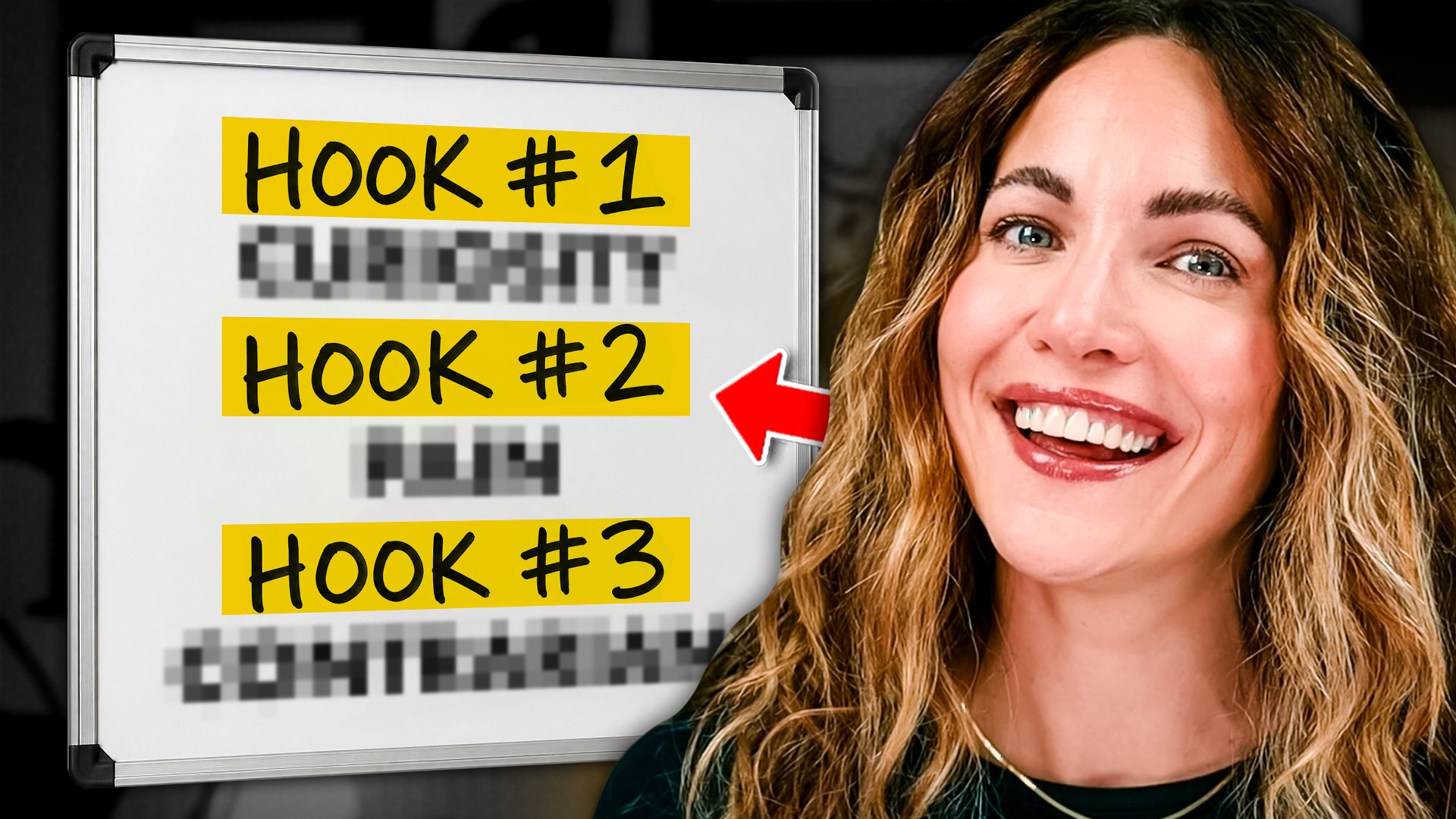
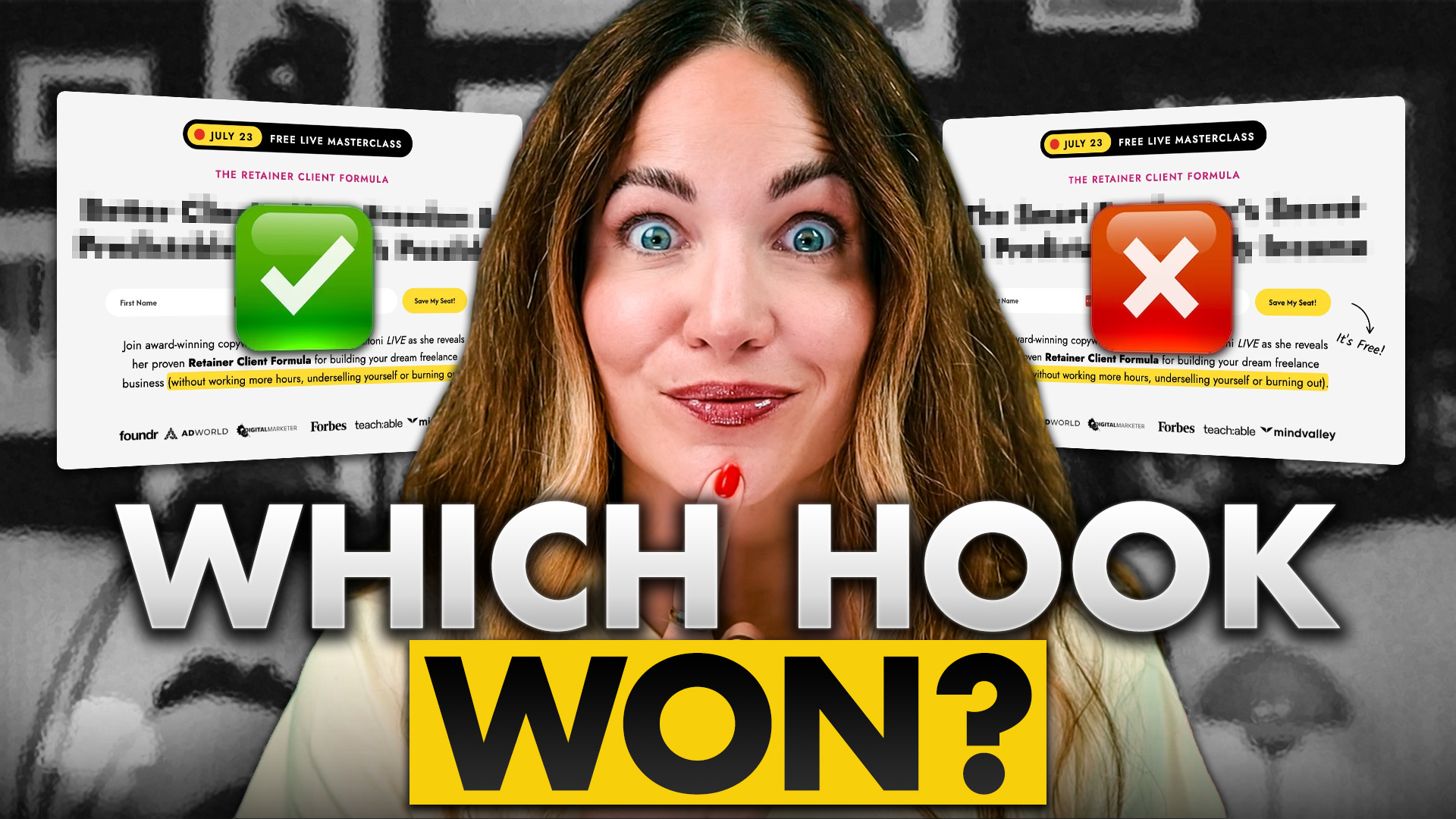
And that is why your hook is arguably the most important sentence of your entire script. If you want to go deeper on this, I’ve broken down the exact hooks that stop people from scrolling here, and even tested 5 different hooks head-to-head with real ad data if you want to see the numbers behind it.
Great hooks don’t just tell people what the video is about.
Great hooks trigger an emotion and open a question in the viewer’s mind.
An information gap between what they currently know, and what they suddenly want to know.
Let’s rewind for a sec and replay the very first sentence of this post.
“There is one scriptwriting formula that I follow for every single video I create. And in the past two years alone, the videos I’ve published on YouTube have generated more than $1.8 million dollars for my business.”
Notice I didn’t start the video by saying “Hey guys, what’s up. It’s Alex and welcome back to my channel.”
Sure, that’s what I would have said without a script, but instead I was very intentional about the title and hook of this video, it wasn’t an accident.
You clicked on a post about “The Exact Video Script Template That Made Me $1.8 Million.“
So I opened by immediately reinforcing the promise you clicked for, and immediately showed proof of how powerful this formula has been in my business.
I am strategically engineering attention. But here’s where a lot of creators go wrong, they stop there. Remember, getting someone to stop scrolling does not mean you’ve earned their attention for the entire video.
You’ve really only earned it for a few seconds, and you can lose it like that.
So how do you turn those few seconds into a few minutes? Well.
That brings me to Force #2.
FORCE #2: RETENTION
Most creators think the goal of a hook is to get attention. And it is, but that’s only half the job.
The real goal is to get and keep attention.
Hook them, and then keep them hooked.
Because we’ve all clicked on a video with a juicy title, and 5 seconds later thought: “Yeahhhh, I don’t care anymore.”
Click.
This is where most scripts fall apart.
Attention is not something you earn once. It is something you have to keep earning, over and over again.
Sentence by sentence. And one of the most powerful ways to do that is with something called an Open Loop.
An Open Loop is essentially an unanswered question.
A promise that hasn’t been fulfilled yet.
An itch that needs to be scratched.
A tiny piece of information your brain needs to resolve.
Open Loops are the reason you binge-watch 8 episodes of a show in a single night, you have to know what happens next.
Great scripts (and yes, Netflix shows) strategically sequence these loops so there is always a reason to keep watching.
You close one loop, but before you do, you open another, and you do this throughout your entire video.
I call this an Open Loop Chain, and yes, you’re in one right now.

Remember what I told you at the beginning of this post? I told you to pay especially close attention to the fourth force because it’s the one almost all creators forget.
And the one that turns video views into actual results.
I haven’t told you what it is yet. That loop is still open.
Which means, whether you realize it or not, there’s still a little unanswered question niggling in your brain. “Okay, so what’s #4?”
I am strategically engineering retention in this script.
And it’s something you can (and should!) do throughout every single script you write.
You can drop a hint of something coming later.
Ask a question you don’t immediately answer.
Create a cliffhanger.
Or bridge one idea to another.
But there’s a catch.
Because you can have the greatest hook in the world.
And use amazing open loops to keep someone glued to your video.
But if what you’re actually saying is just a bunch of AI garbage and nothing actually worth listening to?
None of these tricks are going to save you. And that brings me to arguably the most important currency in marketing right now.
FORCE #3: TRUST
This is where a lot of marketing advice gets it wrong.
People don’t buy from you simply because they want what you’re selling.
There are probably dozens, maybe even hundreds or thousands, of people selling the exact same thing you are. People buy from you because they trust you.
And video gives you an incredible opportunity to build that trust.
Here’s what’s changed. We are living through the Information Apocalypse. Thanks to AI, everyone has access to basically the same information.
It’s free. And you can get it in about 10 seconds flat.
You want 10 tips for writing a better headline? ChatGPT can give you 100.
You want to know how to grow tomatoes?
Plan a trip to Italy?
Write an email?
Create a morning routine?
Meal plan?
AI can plan an entire meal plan for you, taking into account the exact contents of your fridge and pantry and staying within your macros.
Information alone is no longer scarce. But do you know what is becoming incredibly scarce?
Trust. So people aren’t online looking for more information.
They’re looking for someone who can take that information that’s out there, and make that information make sense.
Someone who can relate to them and their experiences, results, proof and real-life stories.
Someone who can communicate ideas in a way that’s actually enjoyable to consume.
That’s exactly why, when I started my own business, I chose to do it primarily through video. Here on YouTube.
When I started my YouTube channel, I had no experience in front of a camera. I was not naturally good at this.
But what I was, was a copywriter with over a decade of experience writing copy that hooked attention and converted readers into paying customers.
So I took what I already knew about attention, persuasion and human psychology.
And applied it to video scripts.
And over the last 7 years, I’ve created nearly 2,000 videos across all my social media platforms.

Built a multi-million-dollar business centered around video content.
And in the past two years, my YouTube channel alone has brought in more than 36,000 leads and $1.8 million dollars in revenue.

Did this happen because every person who watched one of my videos immediately bought something from me?
Ha! Hell no! But every video gave me time with my audience.
Time to teach.
Time to tell stories.
Or time to demonstrate expertise.
Time to show people what I believe.
And over time, that builds trust into something real and substantial.
Now here’s where things get interesting.
Because attention gets someone through the door.
Retention keeps them in the room.
Trust makes them actually care about what you have to say, and keep watching.
But none of those things automatically convert.
And remember what I said at the beginning?
This final force is the one most creators completely forget, which means they’re putting all this work into creating content.
And then leaving the biggest opportunity sitting on the table.
Your viewer should never finish your video wondering, “Um, okay, now what?”
You want every piece of content to naturally lead the viewer to the next step.
That might be watching another video.
Or downloading a resource.
Or joining your email list.
And even maybe buying your product.
Whatever makes sense for that piece of content.
But here’s the important part.
Your CTA should not feel like some random commercial you slapped onto the end of the video.
It has to feel like the natural continuation of what they just learned.
If you’ve done the first three forces correctly, you shouldn’t have to suddenly switch into “sales mode.”
The next step should make sense.
Let me show you exactly what I mean.
Because this entire post has been following the same scriptwriting framework I’m teaching you right now.
I got your attention with the $1.8 million hook.
I used Open Loops throughout the script to create retention.
And I built trust by giving you real value, sharing my experience and showing you how these principles work inside this very post.
Which leaves us with.
FORCE #4: DIRECTION
Or a clear next step for the viewer. I’ll show you an example of exactly how to do this at the end of this post because I may or may not have a very exciting next step for you. So don’t leave yet.
Because knowing these forces is one thing, but knowing exactly where and how to engineer them into a finished script is what separates the amateurs from the pros.
Like, how do you write a good hook that is proven to work?
What do you do immediately after the hook?
How should you place and structure open loops?
How do you strategically structure the script so you don’t end up rambling for 27 minutes?
And how do you transition into a CTA so naturally that it feels like the obvious next step instead of a hard sell?
I got you. That is exactly why I created HOOKED My Video Script Writing Program.

Inside HOOKED, I’m giving you the exact scriptwriting system I’ve developed after seven-plus years of creating video content.
You’ll learn the 8 hook formulas I use to grab attention.
The 4 Open Loop frameworks I use to keep people watching.
And, most importantly, you’ll get my exact, step-by-step script blueprints for:
- Short-form videos.
- YouTube videos like this.
- Live webinars.
- And sales videos and VSLs.
It’s my entire video script blueprint toolkit where I break down exactly what each script must include to get, keep and convert attention.
And I even created a bundle of Claude Skills to help you analyze and craft video scripts that work, which means more views, more trust, more sales.
If you want the complete system, you can join me inside HOOKED.
Until next time, I’m Alex. Ciao for now.